
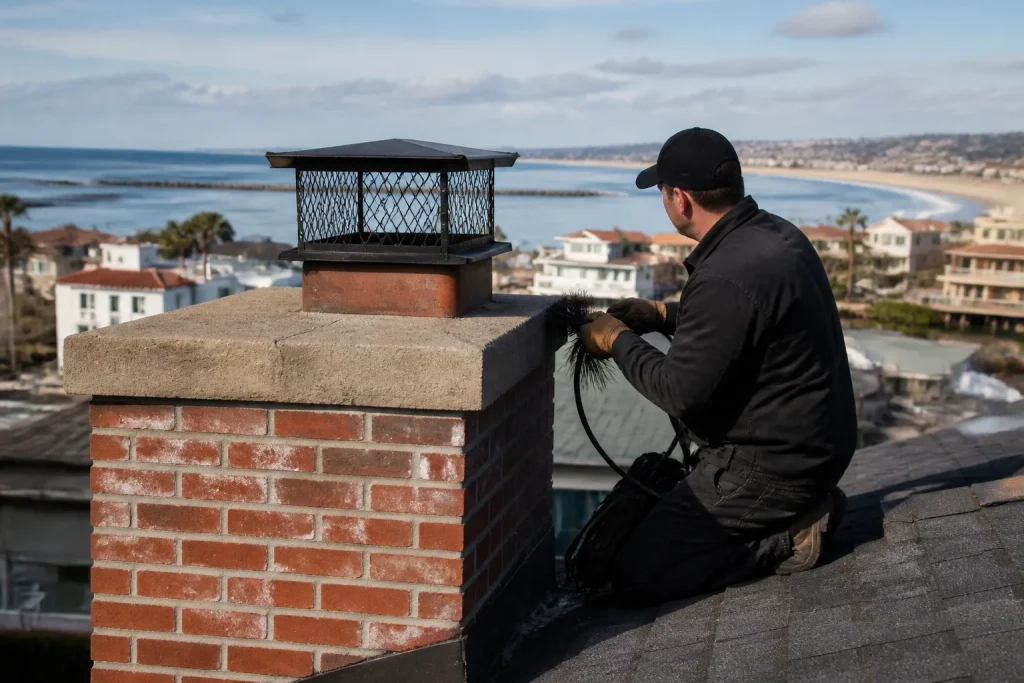
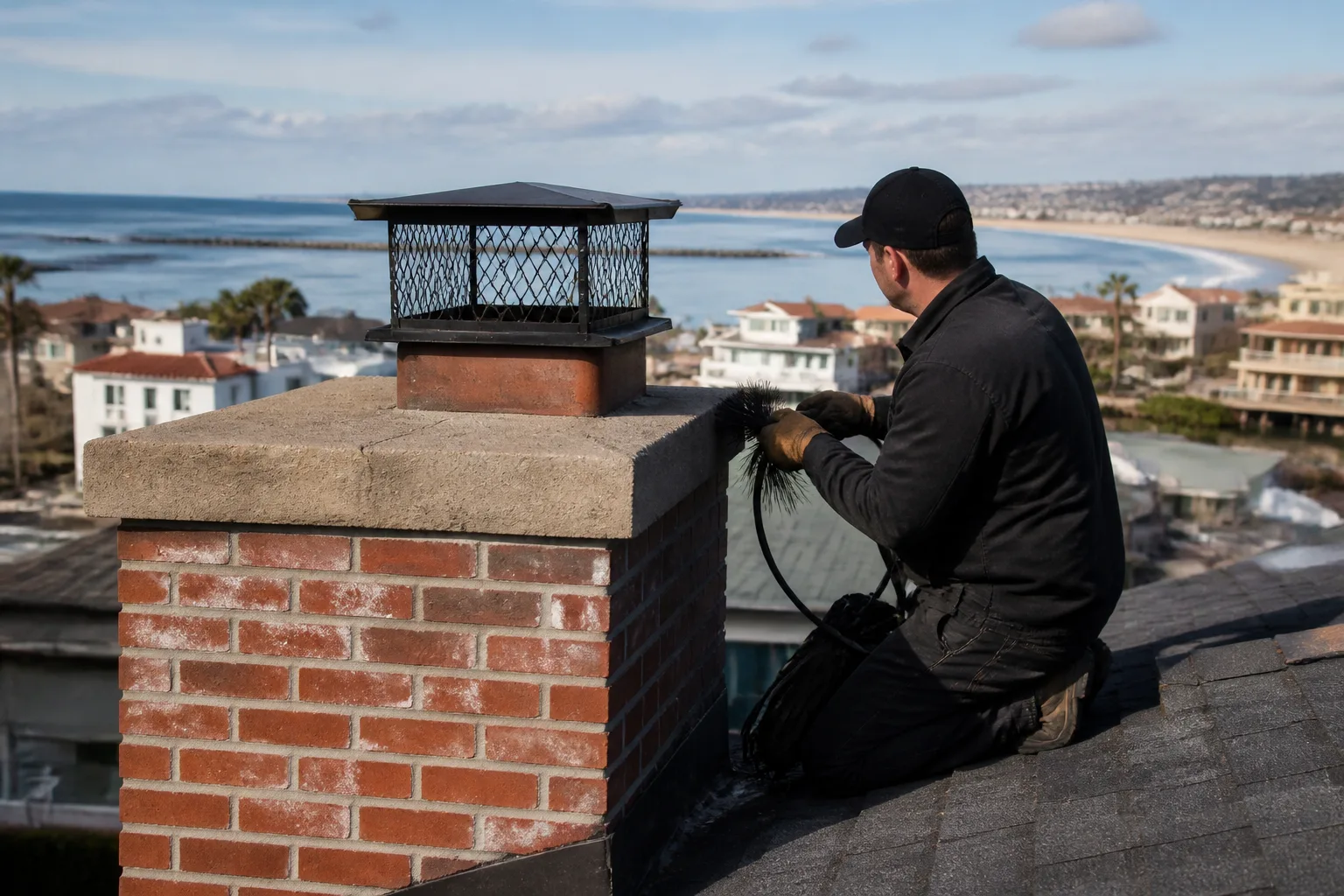
Chimney Sweep: Repair or Replace? How Newport Beach Homeowners Decide
A 40-year-old chimney can be in better structural shape than a 15-year-old one, so the age question is almost beside the point. What actually drives the repair-or-replace decision is which specific component is failing, what caused it, and whether that failure is isolated or a sign of something bigger. Homeowners in Newport Beach who get this wrong tend to fall off one of two cliffs: paying for a repair that won’t hold, or approving a full rebuild they never needed.
We inspect before we sweep, so the answer comes from evidence you can see, not a guess. If you’d rather not sort through it alone, call (844) 573-0875 and we’ll start with a documented inspection.
Key Takeaways
- Chimney age tells you very little. Component condition tells you almost everything.
- A flue liner, firebox, crown, cap, and exterior masonry each have their own repair thresholds.
- Moisture is the most common root cause behind repeat failures. A repair that ignores it will fail again.
- A Level 2 inspection with camera findings is the real decision-making tool, not a visual glance.
Why isn’t chimney age the deciding factor?
Because a chimney is a system of parts that age at very different rates. A masonry chimney built decades ago with a sound crown and a properly sized liner can outlast a newer prefabricated metal chimney whose sections have rusted through from trapped water. We’ve pulled apart the thinking on thousands of these and the pattern holds: the calendar is a poor guide, and the parts are a good one.
Here’s the component-level decision framework we work through, from the firebox up:
- Flue liner: Cracks, gaps, and spalling in a clay liner, or a rusted-out metal liner, are the classic triggers. If the damage is localized, a resurfacing system can often restore it. If the liner is broadly compromised or the wrong size for the appliance, replacement is the honest call.
- Firebox: Cracked firebrick or deteriorating mortar joints can be rebuilt in place when the surrounding structure is sound. Widespread failure across the firebox usually points to a rebuild.
- Crown: The crown sheds water off the top. A hairline crack can be sealed. A crown that’s separated, crumbling, or improperly sloped needs to be recast.
- Cap: A missing or damaged cap lets water and animals straight into the flue. This is almost always a repair, and a cheap one relative to what a wet flue costs later.
- Exterior masonry: Spalling brick, eroded mortar joints, and leaning are the heavy end. Localized repointing is routine. A chimney that’s pulling away from the house is a rebuild conversation.
Each of these has its own threshold. The skill is in knowing whether the failing part is a standalone problem or a symptom of a structural issue affecting the whole stack.
What does a Level 2 inspection actually tell you?
A Level 2 inspection is the tool that turns “it looks fine” into a decision you can defend. It uses a camera run through the flue so the inside of the chimney, not just the visible firebox, gets examined. That’s where the real evidence lives, and it’s why we treat inspection as a standalone, documented service rather than a quick look before the sweep.
The camera findings map fairly cleanly onto repair tiers:
- Isolated liner cracks and surface deterioration: a resurfacing system like HeatShield can restore the liner without the cost of full relining.
- Sectional liner damage or an undersized liner: a flexible liner system such as DuraFlex is typically the fix.
- Firebox or crown failure with a sound structure: targeted repair, using Gelco or Famco components built for longevity.
- Damage spanning multiple components, or structural movement: this is where a rebuild starts to make financial sense.
The important part for a homeowner is that the camera evidence is something you can see for yourself. You shouldn’t have to take anyone’s word that a liner is “shot” or a crown is “failing.” A documented report also carries weight for a real estate transaction or an insurance review. Learn more about our chimney inspection if you want to understand what the report includes.
How does coastal Newport Beach weather drive chimney failures?
Salt air and the marine layer moisture that settles over Newport Beach accelerate specific failure modes, and they hit masonry and prefabricated metal chimneys differently. Moisture is the thread that runs through nearly every repair-versus-replace call we make here.
On brick-and-mortar chimneys, the constant damp-and-dry cycle works on the mortar joints and the crown first. Joints soften and erode, the crown cracks, and water finds its way into the masonry. Once brick stays wet, it spalls, and a spalled brick is one that’s given up. Thermal cycling, the daily warm-and-cool swing, opens small gaps further over time. The moisture problem compounds quietly.
Prefabricated metal chimneys fail on a different track. Moisture that gets past a bad cap or a poorly sealed joint corrodes the metal sections from the inside out, and a rusted-through section can’t be patched the way a brick can. That’s often where replacement of the liner becomes the smarter move.
The takeaway for a Newport Beach homeowner is this: identify whether water is getting in, because that answer shapes whether a repair will hold. A cap and a sound crown are the first line of defense. We carry and install caps and crowns using brands like Gelco and Famco because the components need to last through years of this climate, not one season. That’s part of our chimney cap and crown work, and it’s preventive by design.
Will a repair last, or is it treating a symptom?
A repair holds when it addresses the cause. It fails when it only addresses the visible damage. This is the distinction that separates a fix from a temporary patch, and it’s the question to ask before approving any work.
The most common root cause is moisture. If water is entering through a cracked crown, a missing cap, or failed flashing, then rebuilding a firebox or resurfacing a liner without fixing that entry point guarantees the same failure returns. In our experience, repeat problems almost always trace back to a moisture source that was never closed off.
Here’s how to tell the difference:
- Ask what’s causing the failure, not just what’s damaged. A specific cause means a specific fix.
- Check whether the plan includes stopping water at the top. If it doesn’t, ask why.
- Insist on seeing the camera evidence so the recommendation stands on something visible.
- Be wary of a repair quoted before any inspection of the flue interior.
A professional-grade repair treats the cause. A patched symptom just resets the clock on the same bill.
Sequential repairs or one fix now: which math wins?
This is the economics question, and it deserves a straight answer. Sequential repairs, one component at a time, can look cheaper up front. But when the failures share a root cause, doing them piecemeal usually costs more across a few years than addressing the cause once.
The math tilts toward doing more now when the same moisture or structural issue is driving multiple failures. If the crown, the flashing, and the liner are all showing damage from the same water source, repairing them one at a time means paying for the same root cause repeatedly. It also means the chimney keeps degrading between repairs. In those cases, one coordinated fix is the better spend.
The math favors a staged approach when the failures are genuinely unrelated and isolated. A worn cap on an otherwise healthy chimney is a standalone repair. A single hairline crown crack on a sound structure is a standalone repair. There’s no reason to escalate.
An honest assessment tells you plainly when work can safely wait. Nothing should be recommended without camera evidence you can see for yourself. That’s the standard we hold to, and it’s the difference between a recommendation and a sales pitch.
When to call a pro
Some of this you can check yourself: a missing cap or a visibly crumbling crown at the top of the stack is worth a call. The inside of the flue is a different story. Liner cracks, firebox deterioration, and corrosion happen out of sight, and the high-tension spring and structural aspects of chimney work are genuinely dangerous to handle without training. A professional inspection is how you find out what you’re actually dealing with before it becomes a larger repair. If you’d rather not climb up there and guess, we’ll bring the camera and show you.
For the routine side of things, our chimney sweep keeps the flue clear of creosote, and our fireplace repair handles the firebox and firebrick. When the structure above needs work, that’s our chimney repair service. All of it comes from one company across the full chimney, from firebox to crown, with professional-grade parts from brands like DuraFlex, HeatShield, Olympia Chimney, and Copperfield. No handoffs, no second contractor.
The Bottom Line
The repair-or-replace question is a component question, not an age question. Work through it in order: find the failing part, identify the cause, and check whether the evidence backs up the recommendation. If moisture is behind the failure, fix the source or the same problem comes back. If the failures are isolated and unrelated, a staged, targeted repair is the right spend. If they share a root cause or span the structure, one coordinated fix usually costs less over time.
You shouldn’t have to verify thousands of dollars of work on trust. Nothing gets recommended without camera evidence you can see, and we’ll tell you straight when a repair can safely wait. If you’re in Newport Beach and need help, Newport Beach Chimney Sweep Pros offers free estimates, and the written estimate sets the final price. Call (844) 573-0875. We answer 24/7, with fast dispatch from 7am to 7pm, Sunday through Friday. Start with a Newport Beach Chimney Sweep Pros inspection and a clear answer you can act on.
Frequently Asked Questions
It depends on which component is failing and why, not on the chimney’s age. A camera inspection reveals whether the liner, firebox, crown, cap, or masonry is damaged, and whether one cause (usually moisture) is behind several failures. Isolated damage on a sound structure is a repair; damage spanning components or showing structural movement points toward replacement. Call (844) 573-0875 for a free estimate with documented findings.
Sometimes, yes. A liner with localized cracks or surface deterioration can often be resurfaced with a system like HeatShield, which restores it without full relining costs. A liner that’s broadly compromised, corroded through, or undersized for the appliance usually needs replacement with a flexible liner. The camera findings decide which. Call (844) 573-0875 to get an exact quote, and estimates are free.
Because the repair treated the symptom, not the cause. If water is entering through a bad crown, a missing cap, or failed flashing, any repair made without closing that source will fail again. Ask whether the plan stops water at the top, and check that the recommendation rests on camera evidence. We answer 24/7 at (844) 573-0875 if you want a second look.
It depends on whether the failures share a root cause. Unrelated, isolated problems are fine to handle one at a time. When the same moisture or structural issue is driving multiple failures, one coordinated fix costs less over the years than paying for the same root cause repeatedly. A documented inspection tells you which situation you’re in. Call (844) 573-0875 for a free estimate.
Written by the team at Newport Beach Chimney Sweep Pros.
Need Chimney Cleaning Help?
Call Newport Beach Chimney Sweep Pros - the local pro we connect you with is licensed and insured, with free written estimates in Newport Beach.
(844) 573-0875